
The Implement AI Podcast #73 – AI Execution, Organisational Redesign, and the Change Leaders Cannot Avoid
February 24, 2026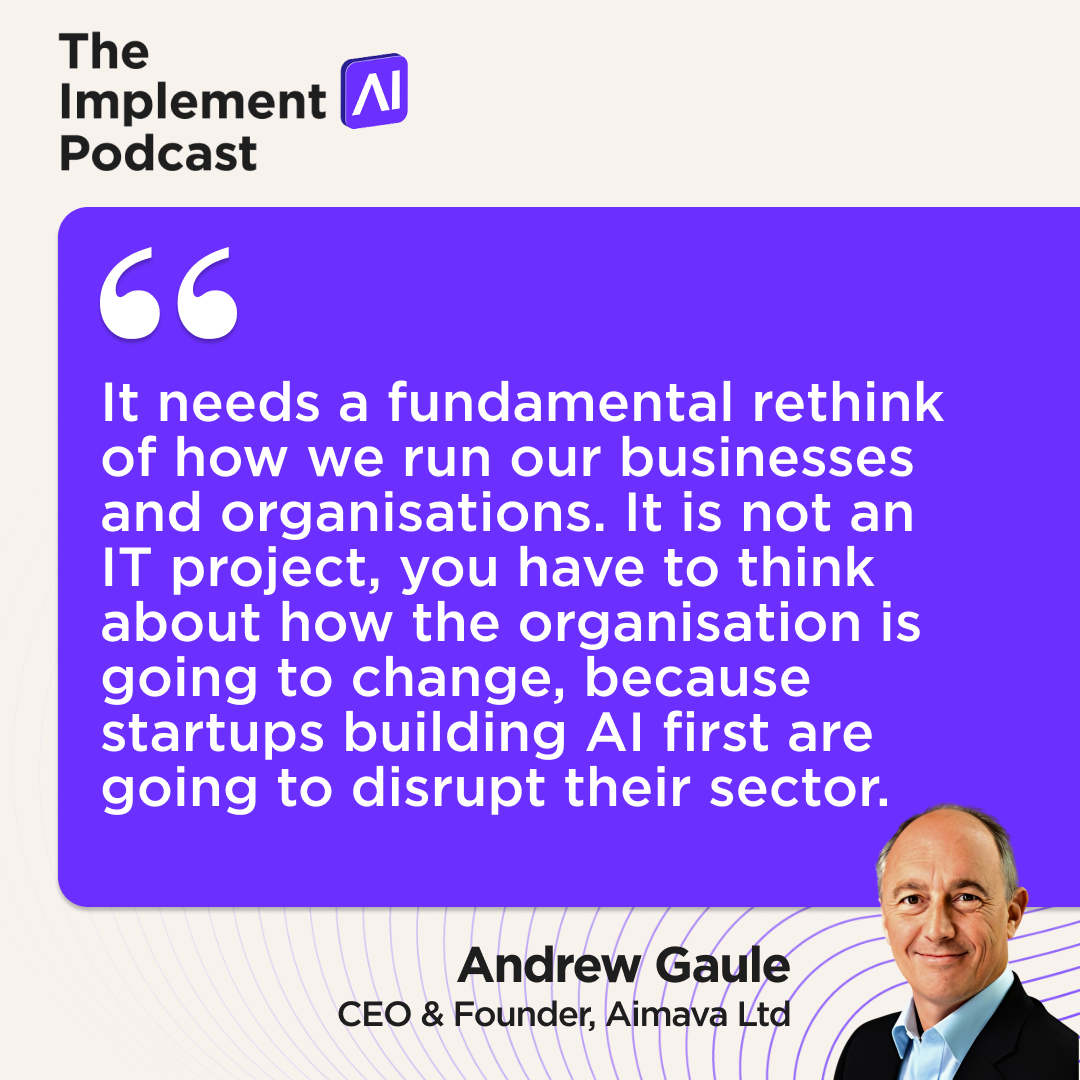
There is a recurring theme that surfaced in this episode of The Implement AI Podcast, and it is something anyone working inside a real organisation will recognise immediately:
Most companies say they want to implement AI, but when you look beneath the surface, the structure required to support that ambition is not there. It becomes obvious the moment teams try to move beyond talking and into actual deployment.
Leaders get excited about the idea of AI agents, digital workers, and operational efficiency. Someone says, “Let’s just spin up a pilot and see what happens.” Two months later, everyone is stuck wrestling with ownership, access to inputs, internal sign-off, unclear boundaries, IT concerns, and competing priorities across functions.
In this episode of The Implement AI Podcast, Piers Linney and Dr Aalok Y. Shukla sit down with Andrew Gaule, CEO and Founder of Aimava, to examine the shift redefining how organisations prepare, scale, and execute AI.
The uncomfortable truth surfaced throughout this conversation is this:
AI fails not because the technology is weak, but because the organisation surrounding it is not designed to support it.
For years, transformation initiatives centred around new systems and tools. CIOs deployed software, automated steps in workflows, upgraded infrastructure, and reported digital progress in terms of platform adoption.
But AI is different. AI is not a tool. AI is an operating model change.
As Andrew Gaule states:
“It needs a fundamental rethink of how we run our businesses and organisations. It is not an IT project, you have to think about how the organisation is going to change, because startups building AI first are going to disrupt their sector.”
The startups already doing this are faster because they are not fighting legacy processes or internal politics. Their teams are structured for outcomes, not departments. They make decisions quickly and move straight into production rather than losing months debating feasibility.
Meanwhile, established companies often assume the barrier is skill or funding, when the real barrier is organisational alignment and execution discipline.
Where AI Projects Die: The Pilot Graveyard
One of the most practical themes in the discussion was the growing number of pilots that never reach real deployment.
Organisations invest time and money, run tests, build prototypes, and create detailed decks, but then everything slows down.
The blockers are rarely technical. Most often, they are structural:
- No single owner with decision authority
- Workflow design built for manual, people-driven processes
- Unclear commercial value, so urgency disappears
- Silos operate independently rather than collaborating
- Internal process is slower than the technology cycle
As Piers Linney explained:
“Most companies say they’re ready for AI, but structurally they’re not. They jump to ‘let’s get an agent up and running’ without the alignment, the inputs, or even the ownership needed to make it work.”
This means organisations can spend six months experimenting and still be nowhere closer to production, while AI-first competitors are already running live digital workers handling real capacity.
In the AI age, progress belongs to those who move, not those who analyse endlessly.
The Power of a Single Owner
A critical point Dr Aalok Y. Shukla raised was the need for one accountable leader who can coordinate cross-functional requirements and remove blockers.
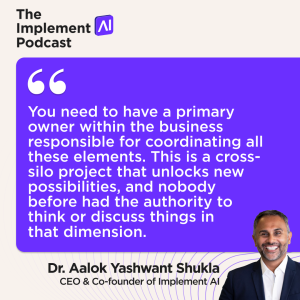
“You need to have a primary owner within the business responsible for coordinating all these elements. This is a cross-silo project that unlocks new possibilities, and nobody before had the authority to think or discuss things in that dimension.”
Ownership is not administrative. Ownership determines pace, clarity, decisions, and results.
Without this role, AI becomes a shared hobby no one is accountable for. With it, decisions happen, confusion disappears, and execution accelerates.
From Experimentation to Execution
One of the most practical parts of the conversation was the implementation blueprint discussed, the ABCDE approach, designed for real-world deployment:
The ABCDE blueprint shared in this episode is practical, structured, and engineered for outcomes:
- A/B: Validate business case and define boundaries clearly
- C/D/E: Add complexity only after proving commercial value
Instead of trying to automate the entire workflow at once, the approach starts by deploying a junior digital worker to handle 30–40% of the work. Over time, edge-case learning compounds and performance increases.
This prevents wasted time, lowers risk, and creates measurable wins early. It also reframes the role of AI from theoretical automation to a blended human + digital workforce that supports growth without scaling headcount.
The Leadership Question
This conversation forces a hard reflection:
Are leaders willing to redesign the organisation to support AI-enabled execution, or are they trying to fit AI into a structure that was not designed for it?
Because the companies that redesign now will move faster, deliver better experiences, and protect their best people from operational drag.
The companies that continue debating will be outpaced by smaller teams operating at a different level of speed.
Key Takeaways
- AI success depends on organisational structure, not software
- Ownership drives speed, committees do not
- Pilots without deployment mechanics are wasted effort
- AI-first companies win because they execute, not because they have better ideas
- Commercial velocity is now a competitive advantage
Final Thoughts
The companies that succeed in the next phase of AI will not be the ones spending the most time talking about it. They will be the ones redesigning how decisions are made, how responsibility is held, and how work flows across teams.
The decision is not whether AI replaces people. The decision is whether AI frees people to do work that matters or whether outdated structures continue holding them back.
The organisations that act now will shape the next decade.
The ones that wait will be reshaped by it.
🎧 Listen to the full episode now:
Apple: https://bit.ly/4a52uYB
Spotify: https://bit.ly/3Mpds1k
YouTube: https://bit.ly/4oHt0uQ