
The Implement AI Podcast #75 – Why Britain’s AI Future Depends on Organisational Change, Not Just Skills
February 24, 2026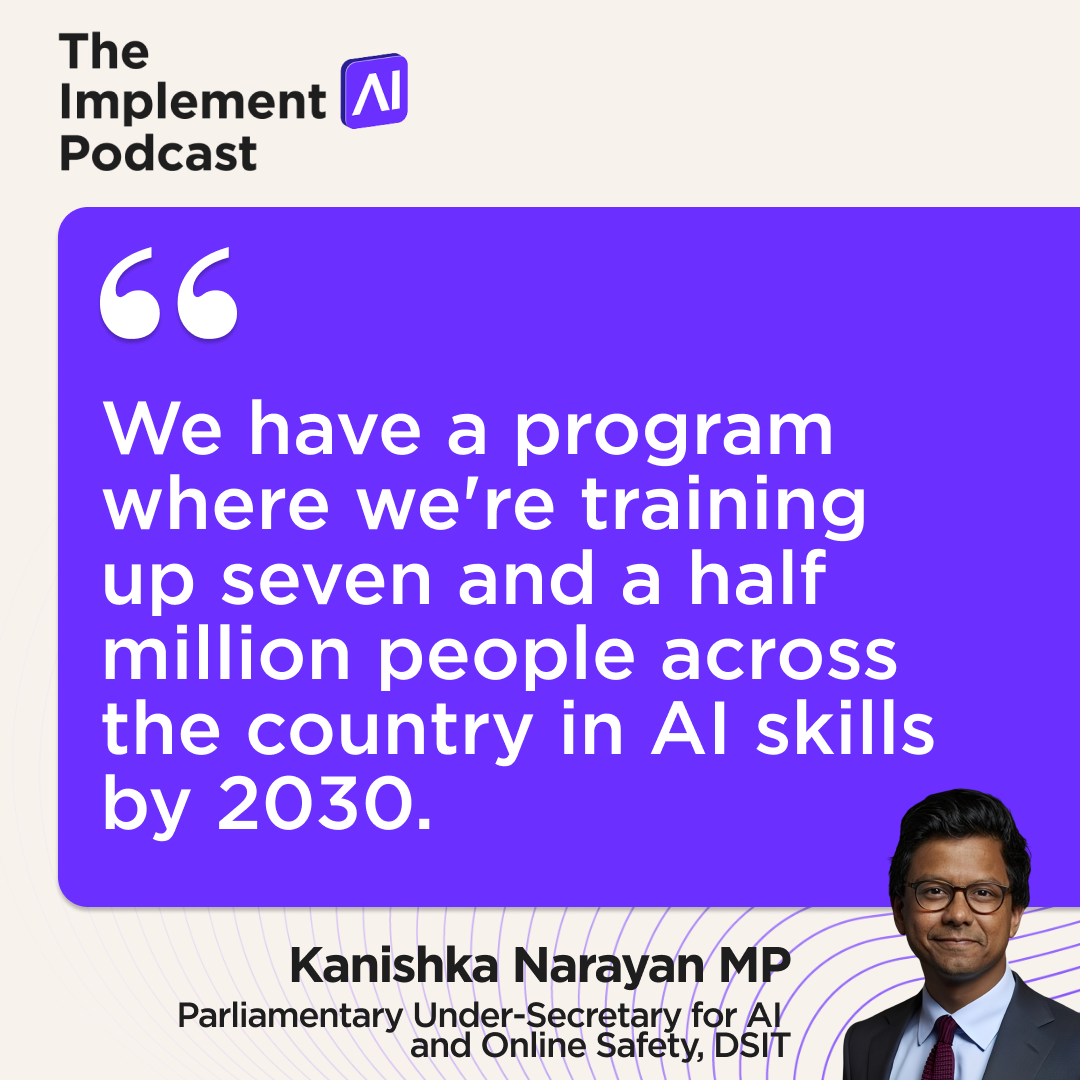
There is a quiet contradiction at the heart of the UK’s AI ambition.
Investment is flowing. Training programmes are expanding. Public excitement around AI has never been higher. And yet, inside most organisations, very little has actually changed. People are experimenting. Businesses are hesitating. Productivity gains remain largely theoretical.
That tension sits at the centre of this episode of The Implement AI Podcast, where Piers Linney MBE and Dr Aalok Y. Shukla are joined by Minister Kanishka Narayan MP, UK Parliamentary Under-Secretary of State for AI and Online Safety, serving in the Department for Science, Innovation and Technology.
What emerges is a clear and slightly uncomfortable truth:
The UK does not have an AI technology problem, it has an AI implementation problem.
Despite billions in investment and world-class research, only around 20% of workers feel confident using AI, and just one in six organisations have formally deployed it. The gap is not about access. It is about readiness.
From Innovation to Implementation
Much of the public conversation around AI focuses on frontier models, computing power, and global competition. But Minister Narayan reframes the issue entirely.
The economic impact of AI, he argues, will not come from inventing radically new models. It will come from embedding existing tools into everyday work, across millions of roles, teams, and organisations.
History supports this view. The steam engine, electricity, and even spreadsheets took decades to deliver their full economic impact – not because the technology failed, but because organisations struggled to redesign how work was done.
AI is following the same pattern.
The government’s £27 million AI skills initiative, including the goal to train 7.5 million people by 2030, is an important step. But skills alone are not enough if organisations cannot absorb them.
The 20% Adoption Gap That Changes Everything
One of the most revealing insights from the conversation is what Minister Narayan describes as an adoption disconnect.
When employees are asked whether they use AI at work, many say yes. But when organisations are asked how many AI licenses they’ve purchased, the number is far lower, often by around 20 percentage points.
In practice, this means people are already using AI informally to draft documents, analyse information, and speed up tasks, while organisations lag behind in governance, tooling, and workflow design.
The result is shadow usage, uneven benefits, and missed opportunities.
This gap highlights a deeper issue:
AI adoption is not an individual learning challenge – it is an organisational transformation challenge.
Without redesigned workflows, new incentives, and leadership alignment, AI simply makes people work faster inside broken systems.
AI as a Cognitive Amplifier, Not a Replacement
Dr Aalok Shukla introduces a powerful reframing that runs through the episode: AI as a cognitive amplifier.
Rather than viewing AI as automation that replaces human labour, it should be understood as a tool that expands human thinking, much like gaining an entirely new way of seeing problems.
AI can scan, summarise, translate, compare, and surface risks at a scale no individual can manage alone. But judgment, context, and responsibility still sit with humans.
When positioned this way, fear gives way to agency.
This shift matters because adoption accelerates when people believe AI makes them more valuable, not redundant. And organisations that communicate this clearly are far more likely to see meaningful productivity gains.
Why Organisations, Not Individuals, Are the Bottleneck
A recurring theme in the discussion is that many businesses are waiting for certainty before acting.
They want perfect regulation. Clear ROI. Proven use cases. Total clarity.
But waiting creates its own risk.
As Piers Linney MBE points out, productivity gaps emerge long before revenue drops. By the time lagging organisations feel the impact, competitors have already embedded AI into decision-making, speed, and cost structures.
For small and medium-sized businesses, especially, the challenge is not ambition but support. They need help not just training staff, but redesigning work itself, from decision flows to role definitions to management capability.
Where Leaders Can Start
The episode makes one thing clear: transformation does not require massive programmes or years of planning. It starts with practical shifts:
- Identify where skilled people are doing low-value, repeatable work
- Redesign workflows so AI handles preparation, analysis, and synthesis
- Train managers to lead AI-enabled teams, not just approve tools
- Measure success in outcomes and throughput, not hours worked
- Create safe environments for experimentation without penalty
Small changes compound quickly when aligned with real work.
Key Takeaways
- AI’s economic impact will come from implementation, not invention
- Training individuals without changing organisations creates frustration, not value
- The real adoption gap sits between informal use and formal deployment
- AI works best as a cognitive amplifier, not a replacement
- Organisational readiness is now a competitive advantage
Final Thoughts
Britain’s AI future will not be decided in research labs alone.
It will be decided inside ordinary organisations in how work is designed, how people are supported, and how quickly leaders are willing to change systems that no longer fit reality.
The question is no longer whether people can learn AI.
The question is whether organisations are ready to let AI change how work actually happens.
🎧 Listen to the full episode now:
Apple: https://rebrand.ly/h3msla3
Spotify: https://rebrand.ly/8ba816
YouTube: https://rebrand.ly/c4e0bd
Resources:
The UK Government AI Skills Hub: This is the primary resource for individuals to access free, structured AI training.
- Link: Digital & AI Skills Hub – Microsoft UK (The official partner hub for the government’s 7.5 million people training initiative).
- The Tech Local Program: This £27 million program provides graduate and work experience placements across the country.
- The AI Workforce Playbook: https://implementai.io/guide/AIOS-Guide.pdf?utm_source=podcast&utm_medium=organic&utm_campaign=download