The Implement AI Podcast #72 – AI, Fractional Work, and the Restructuring of the Workforce
February 24, 2026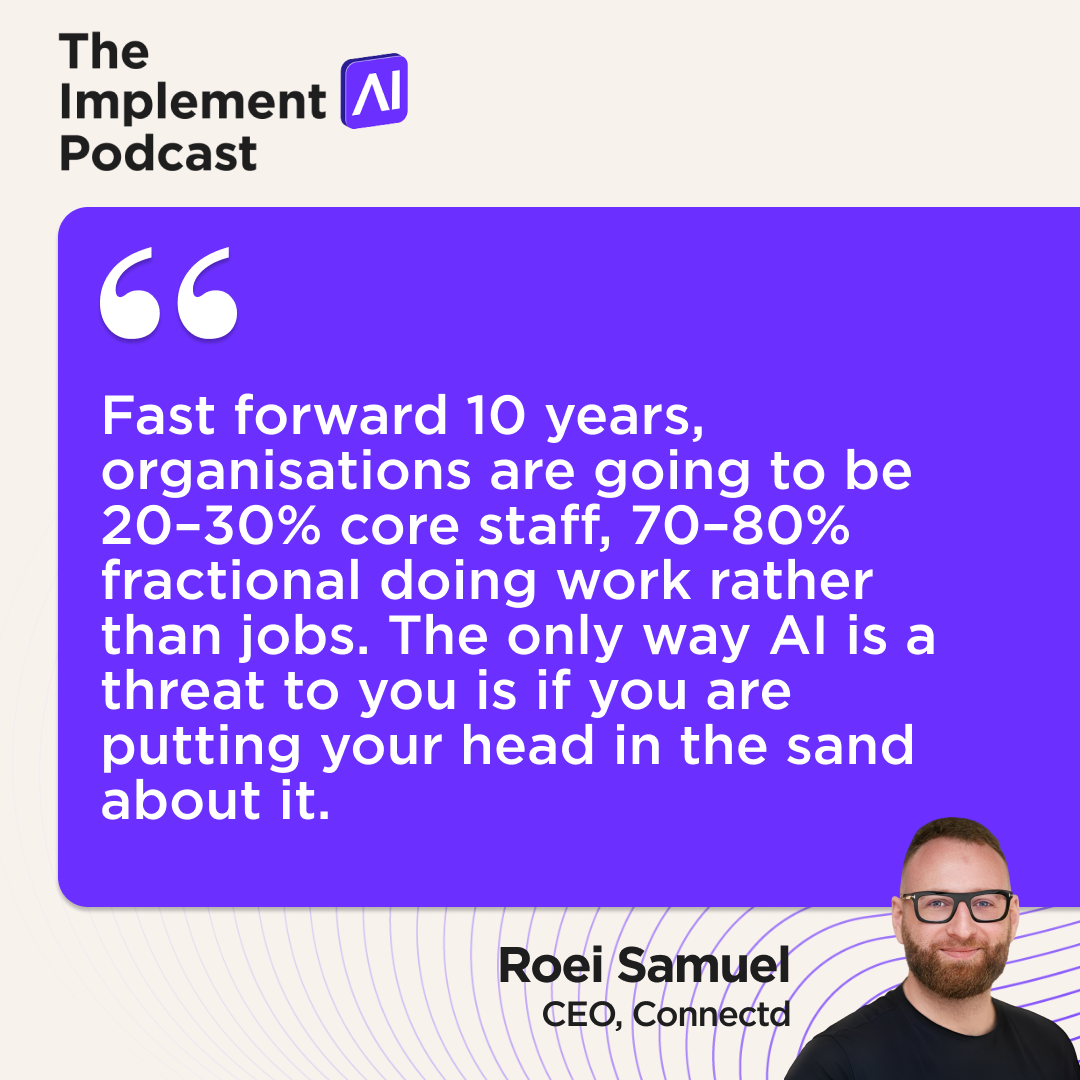
There is a tension running through almost every organisation right now.
Pressure is rising, expectations continue to grow, but capacity is stretched to the edge. People are working harder than ever, yet the gap between effort and results keeps widening. Many businesses tell themselves that they have a talent problem, or a resource problem, or a market problem. But when you look closely, the real issue is simpler and far more uncomfortable: the way work is designed no longer aligns with how work actually needs to be done.
In this new episode of The Implement AI Podcast, Piers Linney and Dr Aalok Y. Shukla sit down with Roei Samuel, Founder and CEO of Connectd, to examine the shift reshaping the modern workforce: the move from traditional employment models to hybrid capacity built on fractional expertise and AI-supported workflows.
This conversation addresses a difficult truth: the traditional employment system is collapsing under the weight of inefficiency, cost, and denial, and organisations that delay redesigning work will lose talent, competitiveness, and capacity long before they lose customers.
From Jobs to Work
For decades, organisations were built on the idea that stability comes from full-time headcount and rigid job descriptions. But growth today demands flexibility, speed, and access to specialised expertise at exactly the moment it is required and traditional structures simply cannot move that fast.
As Roei Samuel puts it:
“Fast forward 10 years, organisations are going to be 20–30% core staff, 70–80% fractional doing work rather than jobs. The only way AI is a threat to you is if you are putting your head in the sand about it.”
People are carrying responsibilities that do not map to their roles, teams are overstretched, and job descriptions are meaningless compared to the real work happening each day. The companies that win the next decade will not be the ones with the biggest payroll, but the ones that build capacity dynamically and intelligently.
The Hidden Cost of Broken Workflows
One theme this episode focused on is the immense loss created by poorly designed workflows. Most employees are burnt out from doing work that does not matter, from cleaning up broken processes, from repeating the same information across multiple systems, and from carrying emotional and operational load that should never reach them.
As Dr Aalok Y. Shukla explains:
“The AI can take the emotional brunt of most issues, but it can also ask the questions to get everything so it’s got a complete ticket so the human can actually solve it. Otherwise it’s a waste of the human’s time to gather scattered information or chase things.”
Anyone who has worked inside a scaling organisation knows exactly what that feels like.
It is the 11pm email chase to finish something that could have been automated.
It is the meeting about the meeting.
It is the frustration of knowing you are capable of more, but being trapped in work that keeps you small.
People do not quit because they cannot handle pressure.
They quit because they cannot justify the waste of their potential.
Protecting the People You Cannot Replace
This is where digital workers, powered by AI, can make an immediate and measurable difference. They remove repetitive load, organise complexity, and deliver complete context before work reaches a human. It means that when a specialist steps in, they are stepping into a problem that is ready for their expertise, not a mess they have to clean before they can contribute.
As Piers Linney describes:
“With an AI and AI agents, you can take out probably at least half of the calls that they’re doing and then you can focus on the keepers, the people you want to keep, and they can then focus on the higher value work. That’s the key.”
This is not about replacing people.
It is about protecting the people who matter most, the ones who carry institutional memory, solve the problems that actually move the business forward, and define the customer experience.
In a market where retention is becoming the true competitive advantage, workflow design becomes a moral and commercial responsibility.
Fractional Talent Plus AI: A Smarter Operating System
Fractional talent is often misunderstood as temporary support or outsourced labour. In reality, it represents a new architecture for organisational capacity.
It allows companies to deploy expert skill exactly where it is needed, rather than stretching generalists across work they are not equipped to handle.
When you combine senior fractional operators with AI-powered execution:
- Work becomes outcome-based, not hour-based
- Skill is applied with surgical precision
- Growth becomes financially intelligent rather than bloated
- Businesses scale dynamically instead of structurally
This is the architecture of the modern workforce.
Where Leaders Can Begin
Redesigning work does not require a large transformation programme. It begins with simple, honest questions:
- Where are talented people spending time that does not require their skill?
- What work is repeated over and over without creating progress?
- Where does context get lost?
- What outcomes actually prove value?
Once those answers are visible, small workflow shifts supported by digital workers and fractional expertise can begin to compound quickly.
Then start small:
- Remove one repetitive workflow and give it to a digital worker
- Add fractional expertise where precision is needed not volume
- Measure outcomes in throughput rather than hours
- Protect the humans you cannot afford to lose
Small structural changes compound faster than big strategy decks.
Key Takeaways
- Capacity is the new competitive differentiator.
- AI protects human ability by removing the friction that breaks it down.
- Fractional talent creates flexibility and precision in moments that matter.
- Burnout is a system failure, not a personal weakness.
- Leaders who redesign work will retain their strongest people.
Final Thoughts
The organisations that win the next decade will not be the ones that defend what once worked. They will be the ones willing to examine their reality honestly, remove the inefficiencies no one wants to admit exist, and build a system that respects human potential rather than draining it.
The choice is no longer between AI and people.
The choice is whether we use AI to amplify skilled people, or exhaust them until they walk away.
🎧 Listen to the full episode now:
Apple: https://bit.ly/3LXRGS5
Spotify: https://bit.ly/4pAOhHA
YouTube: https://bit.ly/4acgoIp