The Implement AI Podcast #77 – Digital Workers, Analyst Agents, and the End of Headcount-Led Growth
February 24, 2026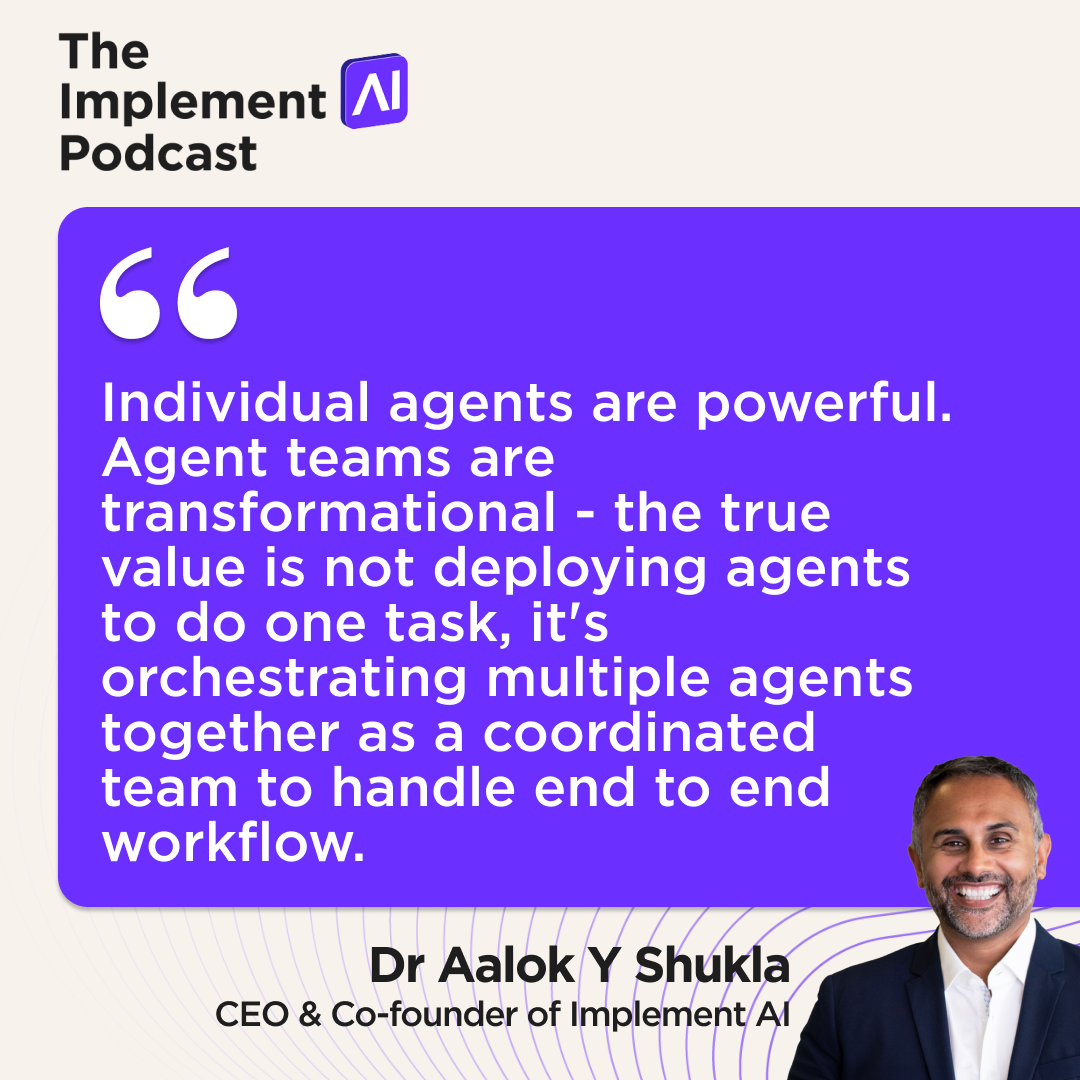
There is a moment many leaders are quietly approaching but not yet naming.
They know AI matters.
They know competitors are experimenting.
They know productivity pressure is rising.
And yet, most organisations are still treating AI as a clever assistant rather than what it really is: a new layer of workforce.
That tension sits at the centre of this episode of The Implement AI Podcast, where hosts Piers Linney MBE and Dr Aalok Y. Shukla break down a practical framework for deploying AI agents not as tools, but as coordinated digital workers.
The key insight is simple but powerful:
Individual agents are impressive. Orchestrated teams of specialised agents are transformational.
The Core Problem: Growth Is Still Tied to Headcount
Most businesses operate under the same invisible rule:
To grow revenue, you must grow people.
Add customers → hire more staff
Expand services → build new teams
Increase volume → increase costs
That’s why so many industries settle into “normal” margins. Different sectors, same constraint.
As Dr Shukla explains, the issue isn’t ambition. It’s structure.
When output is tied to human time, growth is linear. And linear growth keeps margins stuck.
AI agents deployed as digital workers break that link.
Unlike employees, they operate on a pay-per-task model. They work 24/7. They scale instantly. And once deployed, they can be reused across the organisation in ways humans cannot.
This isn’t marginal efficiency. It’s a change in unit economics.
Why AI Agents Change the Economics of Business
Piers Linney frames the shift in financial terms.
If you can increase capacity, responsiveness, and customer experience without increasing your cost base at the same rate, everything changes: margins, valuation, resilience, and speed.
This is where most AI conversations go wrong.
AI is not just about saving time.
It’s about decoupling growth from headcount.
When deployed properly, a network of AI agents can deliver the output of multiple full-time employees for a fraction of the cost by removing the bottlenecks that slow humans down.
But to do that, leaders need to understand that not all agents are the same.
The Three Types of AI Agents (And Why Most Deployments Fail)
Most companies deploy a single chatbot and expect miracles. That fails because it misunderstands what different agents are actually good at.
Dr Shukla breaks AI agents into three categories:
1. Interactive Agents – The Front of House
These are the agents that talk to people.
Customers, employees, partners. Across chat, email, voice, WhatsApp. They hold context across conversations, ask intelligent follow-ups, and know when to escalate to a human.
Where they create value:
- Customer support that troubleshoots before a human ever gets involved
- Sales qualification through natural conversation instead of painful forms
- HR assistance that answers 80% of employee queries instantly
- Customer success outreach that reactivates dormant accounts
They don’t replace teams. They multiply their effectiveness.
2. Action Agents – The Execution Layer
If interactive agents talk, action agents do.
They log into systems, move data, click buttons, update records, and execute workflows.
Two types show up repeatedly:
- Computer-use agents that operate software like a human (even without APIs)
- Task agents that connect directly to systems via API to trigger actions
Where they create value:
- Invoice processing without manual data entry
- Lead enrichment that turns form fills into rich CRM profiles
- Order fulfilment that checks inventory, logistics, and customer updates automatically
- Credit control that follows up on overdue invoices without friction
If a human can do it with a mouse and keyboard, an action agent can learn to do it.
3. Analyst Agents – The Intelligence Layer
These are Dr Shukla’s favourites.
They don’t talk to customers. They don’t execute tasks.
They listen, read, and analyse.
They scan call recordings, emails, tickets, and conversations to find what humans miss:
- Missed upsell signals
- Buying intent buried in support calls
- Competitor mentions
- Follow-ups that never happened
- Patterns across thousands of interactions
This is where companies are discovering revenue that already existed inside their business but was invisible.
The Four Places Businesses Are Quietly Losing Money
Across hundreds of deployments, Linney and Shukla see the same four problems.
1. You Can’t Respond When Customers Are Ready
A huge portion of enquiries arrive outside working hours. Speed decides who wins. AI agents don’t sleep.
2. Your CRM Is Full of Dormant Revenue
Leads you already paid for, customers you stopped speaking to, opportunities that faded simply because no one followed up at the right time.
3. You’re Blind to What Customers Are Actually Saying
Calls and emails are rich with insight. Most companies never analyse them at scale. Analyst agents change that overnight.
4. Support Has Become a Barrier
Queues, menus, and deflection frustrate customers. Interactive and action agents turn support into a filter and accelerator instead.
This Is Not About Replacing People
A recurring theme in the episode is reframing. This is not workforce reduction.
It’s a workforce redesign.
AI agents handle triage, preparation, routing, follow-up, execution, and analysis.
Humans focus on judgment, relationships, creativity, and accountability.
When leaders frame it this way, resistance drops and adoption rises.
Where Leaders Can Start
The playbook is practical.
Start by asking:
- Where are skilled people doing repetitive work?
- Where is response time costing us revenue?
- Where are insights trapped in conversations we never analyse?
- Where does customer demand exceed human capacity?
Then deploy agents task by task, combining interactive, action, and analyst agents into small digital teams.
Small changes compound quickly when they remove structural constraints.
Key Takeaways
- AI’s biggest impact is economic, not technical
- Linear growth models are the real limitation
- Different types of agents solve different problems
- Orchestrated agent teams outperform single chatbots
- Most businesses are sitting on invisible lost revenue
- Speed of implementation is now a competitive advantage
Final Thoughts
The future of work isn’t humans versus machines. It’s whether organisations are willing to let go of models that no longer scale. AI agents don’t just make work faster.
They make entirely new ways of working possible.
The companies that understand that early won’t just survive the next few years.
They’ll define them.
🎧 Listen to the full episode now:
Apple: https://rebrand.ly/0dow2r9
Spotify: https://rebrand.ly/53d089
YouTube: https://rebrand.ly/v5q8l6o