
The Implement AI Podcast #81 – The Play, Prepare, Compete AI Strategy with Matt Brittin CBE
April 14, 2026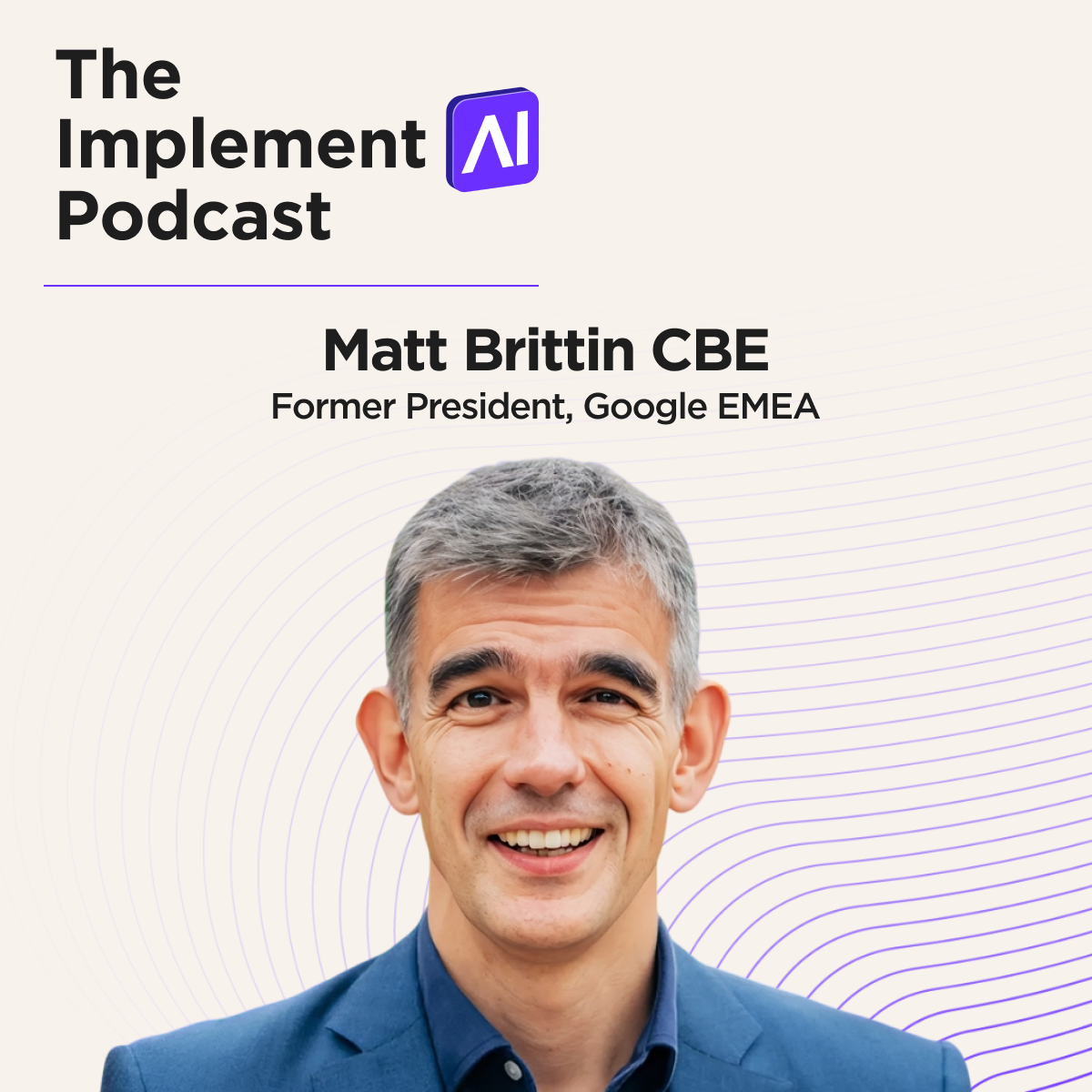
Most businesses today have access to powerful AI tools. Yet very few know exactly where those tools should be used.
This disconnect sits at the centre of a fascinating conversation on The Implement AI Podcast, where Piers Linney and Dr Aalok Y. Shukla sit down with Matt Brittin CBE, former President of EMEA at Google, to explore why AI capability is accelerating while real business adoption still lags behind.
After spending nearly two decades within Google during the rise of machine learning and AI-driven products, Brittin has a unique perspective on the moment businesses are now facing.
His diagnosis is simple:
AI capability is experiencing vertical takeoff.
But most organisations are still on the runway.
The result is a paradox. Businesses know AI matters, but they struggle to identify where it actually creates value.
The Gap Between AI Capability and Business Adoption
Over the past few years, AI tools have become dramatically more powerful.
Systems like ChatGPT, Claude, and Gemini can now perform tasks that once required specialised expertise.
Yet most organisations remain stuck in experimentation mode.
Teams try AI tools.
Leaders discuss AI strategies.
Pilot projects launch.
But few companies have moved into applied AI, where technology becomes embedded into real workflows that drive measurable outcomes.
According to Brittin, the next phase of AI isn’t experimentation.
It’s applied AI – figuring out where AI can be used productively and safely inside the business.
Two Areas Where AI Is Already Delivering Results
When asked where AI adoption is already producing tangible benefits, Brittin points to two clear leaders:
Marketing
Marketing is naturally suited to AI because it revolves around testing and pattern recognition.
Every campaign generates data:
- Which headlines attract attention
- Which audiences convert
- Which creative assets perform best
- Which channels deliver the strongest returns
AI excels in environments where patterns exist but are too complex for humans to analyse manually.
Instead of testing a handful of marketing variations, AI systems can test dozens or even hundreds simultaneously, quickly identifying what works and scaling those insights.
The result is measurable improvements in:
- Customer acquisition costs
- Conversion rates
- Campaign performance
Customer Service
Customer support is another domain where AI can deliver immediate value.
Many customer queries follow predictable patterns:
- Password resets
- Order status requests
- Basic troubleshooting
AI systems can resolve many of these interactions automatically while escalating complex cases to human teams.
This creates a powerful combination:
- Faster responses for customers
- Reduced operational costs for businesses
- Human agents focusing on high-value interactions
The common thread across both marketing and customer service is clear.
They contain three ingredients that make AI effective:
- Large volumes of data
- Complex patterns
- Clear performance metrics
When all three exist, AI becomes extremely powerful.
The Three-Step Framework for AI Adoption
While many organisations struggle with where to start, Brittin suggests something simple: first, learn to play with the technology. Later down the line, you can look into its uses, prepare your business to incorporate AI into workflows and create a competitive advantage.
Step 1: Play
The first step is experimentation.
Teams need to interact with AI tools directly to understand what they can do.
This means:
- Giving employees access to AI systems
- Encouraging curiosity and experimentation
- Allowing teams to explore real tasks using AI assistance
The goal is not immediate transformation.
The goal is demystifying the technology.
Step 2: Prepare
Once organisations understand the capabilities, they need to prepare their data and systems.
AI works best when it can access relevant information.
Preparation may involve:
- Organising internal data sources
- Improving accessibility to operational data
- Establishing governance frameworks
This stage ensures that AI systems can be deployed safely and effectively.
Step 3: Compete
The final step focuses on identifying transformational use cases.
At this stage, leaders should ask:
- Where could AI significantly improve productivity?
- Which workflows could become dramatically more efficient?
- Where could AI create new competitive advantages?
Most organisations don’t need dozens of AI initiatives.
They need one or two high-impact deployments that fundamentally improve performance.
The Real Barrier to AI Adoption
Perhaps the most important insight from Brittin’s perspective is this:
The biggest obstacle to AI adoption isn’t technology. It’s human behaviour.
Many organisations delay action while waiting for certainty.
Leaders want perfect use cases.
Teams want clear policies.
Businesses want guaranteed outcomes.
But AI progress is moving too quickly for that mindset.
The organisations gaining the most advantage are not those with the largest budgets.
They are the ones willing to:
- Experiment early
- Learn quickly
- Apply AI where it solves real problems
Final Thoughts
AI is no longer a distant technology trend.
It is rapidly becoming a core capability for modern businesses.
But success will not come from simply adopting AI tools. It will come from applying them where they create measurable value.
This means focusing on real operational challenges, experimenting with practical use cases, and building a culture that embraces learning.
🎧 Listen to the full episode of Implement AI Podcast:
Apple: https://bit.ly/4egX0Ms
Spotify: https://bit.ly/4dNhPPn
YouTube: https://youtu.be/f5osAEH-rxk