
The Implement AI Podcast #74 – 2025: A Year of AI Insights and Future Predictions
February 24, 2026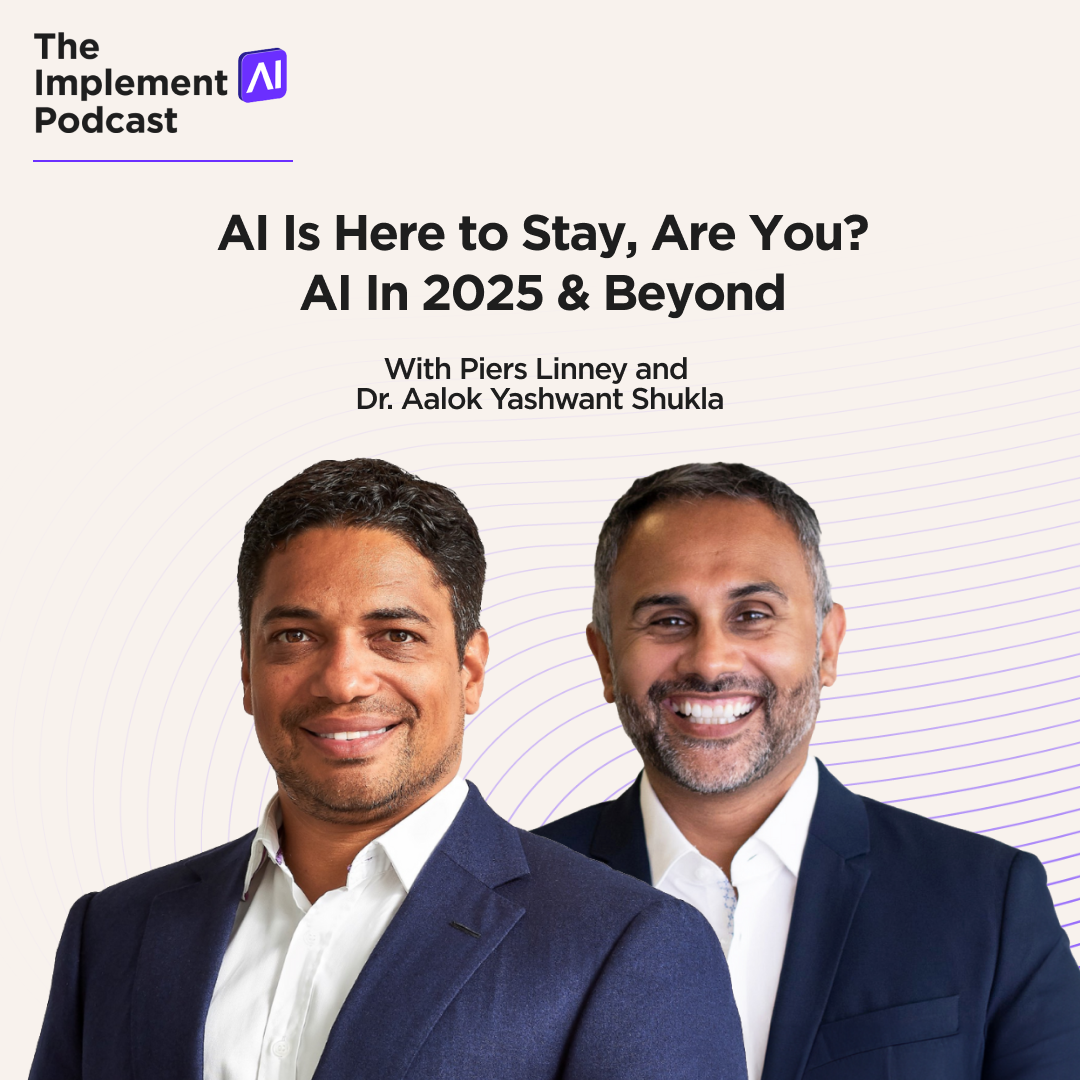
As the year winds down, we look back at 2025 and reflect on the rapid advancements in AI. The year has brought both challenges and opportunities for businesses, as AI technologies have continued to evolve and make a significant impact on various industries.
So today, let’s explore the key insights and predictions for 2026 and beyond, courtesy Piers Linney and Dr. Aalok Y Shukla, hosts of The Implement AI Podcast – which is out now, so take a listen too!
Join us in person on 22 January 2026 for our London workshop, Your Future Digital Workforce, to learn how to practicaly deploy AI agents in your business. Register here.
2025 recap: from hype to practicality
The landscape of AI in 2025 has been marked by a shift from theoretical discussions to practical applications. While AI’s potential has been hyped for years, 2025 saw businesses and industries begin to seriously consider its implementation. More organisations are not only talking about AI but are actively seeking ways to integrate it into their operations. However, the road to adoption has not been without hurdles.
Piers Linney highlights a key insight: as AI becomes more mainstream, organisations are eager to adopt it but often struggle with the practicalities of integration. “People want to adopt AI, but when it comes down to it, many organisations are not ready,” he notes. Despite the growing interest, companies face challenges in aligning their teams, processes, and infrastructure to support AI deployment.
The conversation around AI adoption has matured. Companies are now realizing that implementing AI isn’t just an IT department issue. It requires collaboration across various business functions, including sales, marketing, and C-suite executives. AI’s impact is far-reaching, and its integration requires thoughtful planning, defined use cases, and the right mindset.
Key insights from 2025
Dr. Aalok Y Shukla draws attention to several pivotal developments in AI this year. One major shift has been the rise in public awareness and acceptance of AI. Tools like ChatGPT and voice agents have broken the “uncanny valley,” making AI interactions feel more natural. As a result, people are becoming more comfortable with AI technologies and are now asking, “Where can we apply it first?”
However, the challenge remains: how do organisations define their AI strategy? According to Dr. Shukla, the adoption process is often chaotic. Companies face the challenge of applying AI to poorly defined processes. As AI begins to take over certain tasks, the need for a reimagined workflow becomes apparent. Just like the introduction of trains necessitated the building of railway tracks, AI requires a redesigned infrastructure for optimal use.
AI adoption at the board level
One of the most crucial predictions for the future is that AI will soon become a strategic imperative at the board level. As organisations look to stay competitive and achieve their growth targets, AI will play a central role. Companies that embrace AI early will gain an edge, while those that lag behind risk falling into obsolescence. “If your board is not discussing AI, they’re not doing their job properly,” says Piers Linney. The conversation around AI will no longer be limited to tech teams but will permeate every level of decision-making.
This shift is already happening in some industries. Companies in sectors like cybersecurity and recruitment are using AI to streamline operations, improve efficiency, and deliver better services. As AI continues to gain traction, the companies that are actively using it will outperform their competitors. The focus will shift from being AI-agnostic to becoming AI-first organisations.
The rise of AI agents
Another key insight from 2025 is the rise of AI agents. While there’s been a lot of talk about AI agents transforming businesses, full-scale adoption has not yet occurred. AI agents are still in their infancy, but their potential is immense. These agents can work alongside human employees, augmenting their capabilities and improving overall productivity.
In the future, AI agents will be an integral part of the workforce. However, this will not replace humans entirely. As Dr. Shukla points out, AI will not take over jobs but will rather change how work is done. “The game won’t be about who implements AI, but who understands how to collaborate with AI,” he says. The human-machine partnership will reshape business models and workflows, driving growth and innovation.
Predictions for 2026 and beyond
Looking ahead, the conversation turns to predictions for 2026. As AI adoption continues to accelerate, several trends are expected to shape the future.
- AI Becomes a Board-Level Imperative: The importance of AI will increase at the highest levels of decision-making. Boards will need to have a clear AI strategy to stay competitive.
- The Emergence of Industry Leaders: In the coming years, companies that are early adopters of AI will emerge as leaders in their industries.
- AI-Powered Business Models: The next wave of AI innovation will be driven by new business models that can only exist with AI. Consumers will increasingly demand customized experiences, and businesses will need to innovate to meet those demands.
- AI-Powered Robots and Automation: AI-powered robots are expected to become more prevalent. While the introduction of humanoid robots may be further down the road, industries will see a rise in robots performing specific tasks with precision and efficiency.
- Custom AI Models for Specific Industries: As AI becomes more sophisticated, there will be a shift towards industry-specific models. Companies will create AI solutions tailored to their unique needs, helping them gain a competitive edge.
Conclusion
2025 has been a pivotal moment for AI. While the technology is still in its early stages, it is clear that AI will continue to evolve and play an increasingly important role in business and society. As we look toward 2026, the integration of AI will only accelerate. Organisations that embrace AI with the right mindset and strategy will thrive, while those that resist risk being left behind.
As we continue to explore AI’s potential, it’s crucial for businesses to understand that AI is not just a tool but a transformative force that will reshape industries and job roles. The future is AI-powered, and those who prepare for it will lead the way.
2026, Here we come!
Stick with us on The Implement AI Podcast ride as we continue to bring you the real stories and conversations around AI implementation in 2026 too. We’re here to keep you ahead of the curve. Always.
Wishing you all a wonderful new year! Catch you on the other side.
🎧 Listen to the full episode now:
Apple: https://bit.ly/49nrObs
Spotify: https://bit.ly/4qjj0sL
YouTube: https://bit.ly/4jblven